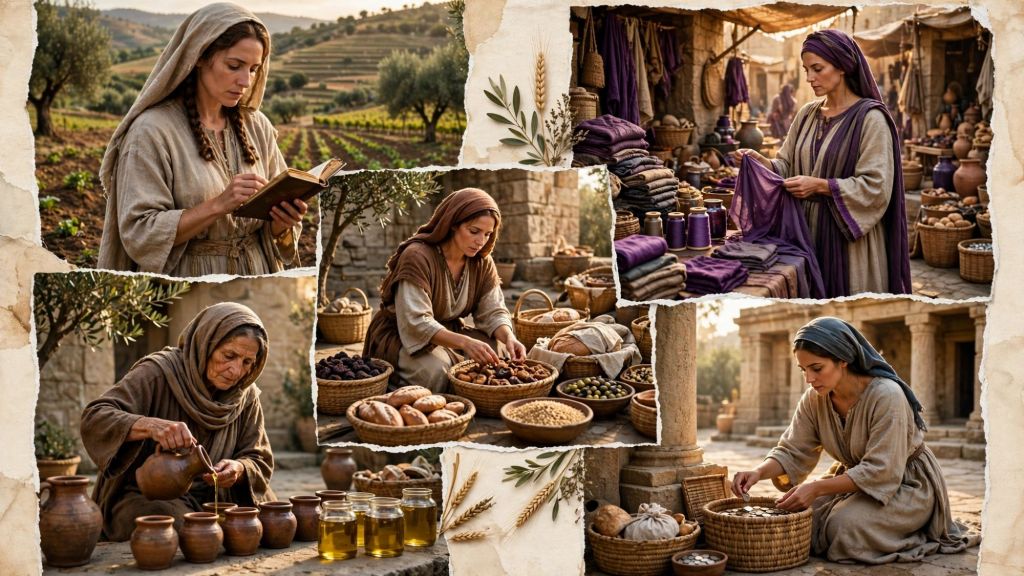
I started paying closer attention to the women in the Bible who handled money, property, business, resources, and household provision.
And something became very clear.
The Bible does not present godly women as financially clueless, passive, or dependent on someone else to think for them.
Quite the opposite.
Many of the women Scripture highlights were economically aware, resourceful, strategic, generous, and deeply involved in the stewardship of what God had placed in their hands.
That alone should make us rethink some of the assumptions we have attached to biblical womanhood.
Take the Proverbs 31 woman.
She is often reduced to cooking, motherhood, and being a good wife. But read the passage carefully.
«“She considers a field and buys it; out of her earnings she plants a vineyard.”
Proverbs 31:16»
She did not simply spend.
She evaluated.
She considered.
She purchased.
She invested.
She produced.
That is financial intelligence.
Then verse 18 says:
“She sees that her trading is profitable.”»
She knew whether her business was making money.
That means she understood value, return, productivity, and profit.
This woman was not merely helping around the home. She was economically active and financially observant.
Then there is Lydia in Acts 16.
Lydia was described as a dealer in purple cloth.
Purple cloth was associated with wealth and status in the ancient world. This was not a casual side hustle. She appears to have been a woman of means, influence, and commercial experience.
When she became a believer, what did she do with her resources?
She opened her home.
Her wealth became a tool for hospitality and ministry.
That is something I noticed repeatedly.
Biblical women who handled resources well rarely treated money as merely personal possession.
They used it for a purpose.
Look at Abigail in 1 Samuel 25.
Her husband Nabal was wealthy but foolish.
When David was enraged and heading toward bloodshed, Abigail acted quickly.
She gathered food, wine, grain, sheep, and other provisions and went out to meet David.
Think about what that tells us.
She knew what was available.
She knew how to mobilize resources.
She understood urgency.
And she used material provision to prevent disaster.
Her financial and household competence literally helped save lives.
Then consider the women who supported Jesus.
Luke 8:1–3 tells us that Joanna, Susanna, and other women helped support Jesus and His disciples “out of their own means.”
Pause there.
Women were financing ministry.
They had resources under their control and chose to direct them toward the work of God.
That is stewardship.
Then there is the widow in 2 Kings 4.
She was in debt, vulnerable, and facing the possibility of losing her sons to creditors.
Elisha did not magically hand her money.
He asked what she already had.
A small amount of oil.
That oil became the basis of her recovery.
She borrowed containers, filled them, sold the oil, paid her debts, and lived on the remainder.
That story carries a powerful principle.
Sometimes financial restoration begins by recognizing the asset already in your hand.
Not everything begins with more income.
Sometimes it begins with better stewardship.
Ruth also teaches something different.
She had almost nothing.
But she worked.
She gleaned in the fields.
She showed diligence, humility, and consistency.
Boaz noticed not merely her poverty but also her character.
So when I look across these women, I see a pattern.
They were not reckless.
They were not passive.
They were not ashamed of productivity.
They considered before they acted.
They worked.
They invested.
They managed.
They gave.
They supported others.
They understood what they had.
And perhaps most importantly, money never appeared to become their identity.
That may be the lesson we need today.
The question is not whether a woman should earn money.
The Bible clearly gives us examples of women doing exactly that.
The better question is:
What is the money becoming in your hands?
Is it becoming security?
Status?
Competition?
Generosity?
Investment?
Family stability?
Ministry?
Legacy?
The Proverbs 31 woman did not compete with her husband through her financial strength. Her contribution strengthened the household.
Lydia’s success created room for ministry.
Abigail’s resources became wisdom in action.
The women around Jesus used money to advance the Gospel.
The widow turned a small asset into debt freedom.
Ruth turned labor into provision.
Different women.
Different circumstances.
Same principle.
Money is a tool.
And wisdom determines what that tool becomes.
Perhaps biblical financial maturity is not measured by how much you earn.
It is measured by whether what passes through your hands leaves your household, your community, and God’s purposes stronger than before.
That is stewardship.
And the women of Scripture understood it remarkably well.


