Your children are studying your marriage. Not the way a student studies for a test, with a book open and a highlighter in hand. The way a child studies anything, quietly, constantly, without telling you they are doing it. They are watching how you greet each other at the door. They are listening to the tone you use when your spouse walks into the room. They are noticing whether you look up from your phone when the other one speaks, and whether the apology ever comes after the argument, and what your marriage looks like when you think no one is paying attention. They are learning what love is, what a husband does, what a wife does, what a home feels like, and what they should expect from their own marriage one day. They are learning all of it from you, and the lessons are being taught every day, whether you meant to teach them or not.
This is not a lecture about being perfect. Your children do not need perfect parents. They need honest ones, and there is a difference that matters more than most parenting books admit. A perfect marriage would teach your children nothing they could use, because they will never have one. An honest marriage teaches them everything they need, because it shows them what to do when love gets hard, when two people disagree, when someone says the wrong thing, when the day is long and the patience is short. The question is not whether your children will learn about marriage from you. They will. The question is whether you know what you are teaching them.
Moses understood this long before anyone wrote a book about it. When God gave Israel his law, he did not tell the parents to set up a classroom. He told them to live the words where their children could see them. “And these words that I command you today shall be on your heart. You shall teach them diligently to your children, and shall talk of them when you sit in your house, and when you walk by the way, and when you lie down, and when you rise.” That is Deuteronomy chapter 6, verses 6 and 7. Notice where the teaching happens. Not at a special event. Not in a formal lesson. When you sit in your house. When you walk by the way. When you lie down and when you rise. The ordinary hours. The kitchen table. The car. The hallway at bedtime. That is the classroom, and the curriculum is your life. Your children are not learning what you believe about marriage from what you tell them on a special occasion. They are learning it from what they see you do on a Tuesday night when you are tired and the dishes are in the sink and your spouse has just said something that annoyed you.
Consider the argument they overheard last week. You remember it, even if you wish you did not. The voices rose. Someone said something sharp. A door closed harder than it needed to. And then, later, the house went quiet, and life went on, and nobody mentioned it again. What did your children learn from that evening? They learned whatever happened next, because the next part is the lesson. If the next part was a cold silence that lasted two days, they learned that when two people hurt each other, the punishment is distance, and the way to survive a fight is to stop talking. If the next part was a slammed door followed by a long night of pretending nothing happened, they learned that the way to handle a wound is to bury it and hope it heals on its own. But if the next part was an apology, spoken out loud, in a normal voice, in front of them, they learned something no lecture could ever teach. They learned that a person can be wrong and still be loved. They learned that sorry is a word grown people say, and that saying it does not make you small, it makes you safe. They learned that a marriage can bend without breaking, and that the bending is not the failure. The refusal to bend back is.
The apology is the most powerful lesson you will ever teach your children about marriage, and it is the one most parents hide from them. We apologize to each other behind closed doors, if we apologize at all, because we are afraid that letting the children see us wrong will cost us their respect. The opposite is true. A child who watches a parent say “I was wrong, and I am sorry, and I will do better” has just watched the strongest thing a human being can do. They have watched someone choose the relationship over being right, and they will carry that picture into every relationship they ever have. They will remember it when they are married and the argument comes and the pride rises and the words are on the tip of their tongue. They will remember that their father could say he was wrong. They will remember that their mother could forgive without keeping a record. That memory will do more for their marriage than any advice you give them on their wedding day.
The same is true of the small daily moments, the ones that seem too ordinary to matter. The way you greet each other at the end of the day is a lesson. Does your face light up when your spouse walks through the door, or do you stay bent over your phone and grunt a hello without looking up? Your children are watching that greeting, and they are learning whether a marriage is a place where a person is glad to be home or a place where a person is tolerated. The way you speak about your spouse when your spouse is not in the room is a lesson too, and it may be the sharpest one of all. Children hear the phone call to your sister where you complain about him. They hear the joke at the dinner party that is funny at his expense. They hear the sigh when her name comes up. And they learn, without anyone telling them, whether a spouse is someone you protect or someone you perform for an audience. “Death and life are in the power of the tongue.” That is Proverbs chapter 18, verse 21. It is true of what you say to your spouse, and it is just as true of what you say about your spouse, because your children are listening to both.
What about the kindnesses they see, the ones you do without thinking? The cup of coffee made before the other one wakes up. The hand on the shoulder as you pass in the hallway. The way you laugh at the same old story like it is still funny. The way you stand up for your spouse when someone outside the family criticizes them. These are the moments that build a child’s picture of what love looks like, and they are far more convincing than any speech about it, because a child can tell the difference between love that is performed and love that is lived. A child who grows up watching two people be kind to each other in the ordinary hours will expect kindness in their own marriage, and they will know what it looks like when it is missing. A child who grows up watching two people be polite strangers will expect politeness and call it love, and they will spend years wondering why their own marriage feels empty.
There is a particular scene that plays out in many homes, and it is worth looking at closely, because it teaches more than parents realize. It is the dinner table with the phones. One parent is scrolling. The other parent is talking to the children. The conversation moves along, but the marriage is not at the table. The bodies are there, but the attention is somewhere else, and the children feel it even if they cannot name it. They learn that a spouse is someone you sit next to while you look at other things. They learn that attention is a scarce resource, and that the phone gets the first portion and the family gets what is left. Now picture the same table with the phones in another room. The parents look at each other. They ask about the day. They listen to the answer. They laugh at something the child says, and the child sees two people who are actually present with each other, and the lesson lands without a word being spoken about it. Presence is a love language, and children are fluent in it long before they can spell it.
The same is true of how you handle the hard seasons in front of them. A marriage goes through seasons when the money is tight, or the job is uncertain, or the grief is fresh, or the distance has grown between two people who used to be close. Children feel those seasons in their bones, even when no one explains them. They feel the tension in the house. They hear the short answers. They notice that mom and dad are not laughing together anymore. What they need in those seasons is not for you to pretend everything is fine. Children know when you are pretending, and the pretending frightens them more than the truth does. What they need is to see you face the hard season together, honestly, in front of them, in a way they can understand. They need to hear you say, we are going through a hard time, and we are going to get through it together. They need to see you pray together, or sit together, or hold hands in the car on the way to the appointment, and know that the two of you are still on the same side. A child who watches their parents carry a hardship together learns that marriage is a shelter, not a stage. They learn that love is not only for the good days. They learn that two people can be afraid at the same time and still be steady for each other, and that steadiness is the thing that makes a house feel safe.
That steadiness is what Paul was writing about when he warned fathers, and by extension both parents, about the effect they have on their children. “Fathers, do not provoke your children to anger, but bring them up in the discipline and instruction of the Lord.” That is Ephesians chapter 6, verse 4. And in the letter to the Colossians he adds the reason. “Fathers, do not provoke your children, lest they become discouraged.” That is Colossians chapter 3, verse 21. The word provoke is a strong one. It means to stir up, to exasperate, to push a child past the point where they can cope. And one of the surest ways to provoke a child is to make them live in a house where the two people they love most are at war with each other and no one will admit it. The child becomes the referee, or the messenger, or the peacekeeper, or the one who hides in their room with the music turned up, and the discouragement settles in quietly, year by year, until the child grows up believing that marriage is a place where people hurt each other and call it normal. The discipline and instruction of the Lord is not only about rules and correction. It is about the atmosphere of the home, and the atmosphere is set by the marriage at the center of it.
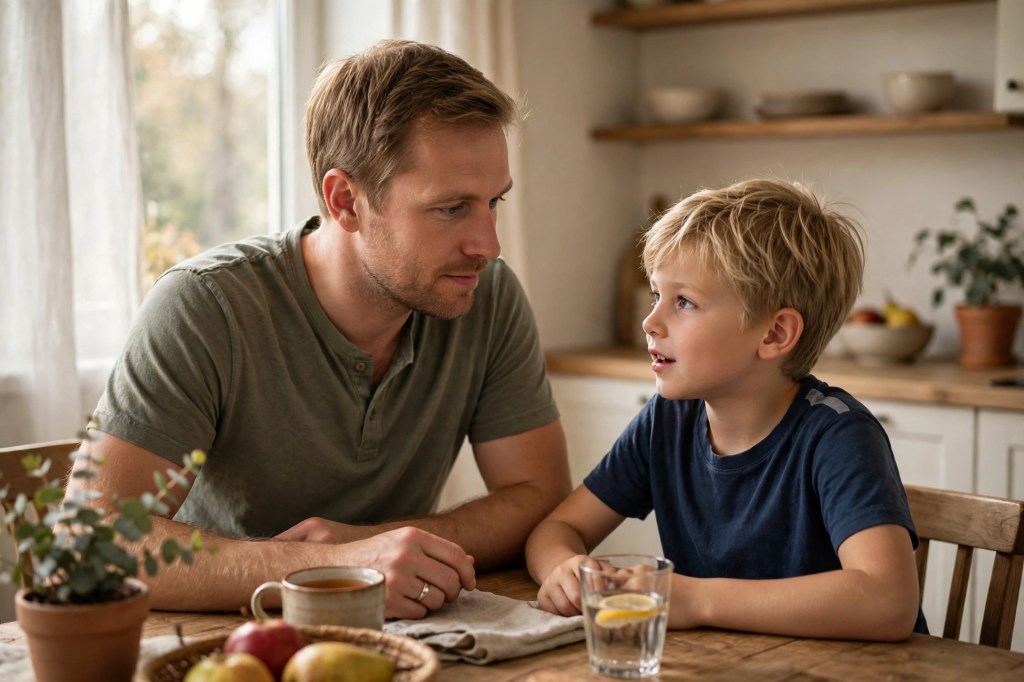
So what do you do with this, practically, this week, in a house where the children are already watching and the lessons are already being taught? You start by paying attention to what they are seeing, and the simplest way to do that is to ask them. Not in a formal sit down, not with a clipboard, but in the car, or at bedtime, or on a walk, when the guard is down. Ask your child what they think a good marriage looks like. Ask them what they notice about how you and your spouse treat each other. Ask them what they wish was different at home. Then listen, really listen, without defending yourself and without correcting the answer. The answers may surprise you. A child will tell you the truth about your marriage in a way no adult ever will, because they have no reason to flatter you and no filter to soften it. If they say you never laugh together anymore, believe them. If they say they are afraid when you argue, believe them. If they say they love it when you hold hands in the car, believe that too, and do it more.
Then make the repair visible. If there is a pattern your children have been watching that you are not proud of, do not try to fix it in secret. Fix it where they can see it, because the fix is a lesson too. If you have been cold to your spouse, let them see you warm up, and let them hear you say why. If you have been speaking sharply, let them hear you apologize and change your tone, and let them watch the change hold over days and weeks, not just an afternoon. If the phones have been at the table, take them away, and tell the children why, in a sentence they can understand. We want to be present with each other, and the phones were getting in the way. That one sentence teaches them more about priorities than a month of lectures about screen time. Children do not need you to be flawless. They need you to be honest about the flaw and visible about the repair, because the repair is where they learn that people can change and marriages can heal.
Let them see the affection too, not as a performance but as a habit. The kiss at the door when one of you leaves for work. The arm around the waist in the kitchen while dinner cooks. The shared joke that only the two of you understand. Some parents worry that affection in front of the children is inappropriate, or that it will embarrass them, and the teenagers will certainly pretend to be embarrassed. Let them pretend. Underneath the eye roll is a child who is quietly relieved to know that their parents still like each other, because a child who knows their parents like each other feels safe in a way that nothing else can produce. Affection is not a luxury in a marriage. It is evidence, and children read evidence. A home where the parents touch each other gently, speak to each other warmly, and laugh together often is a home where a child learns that love is not a word people say at weddings. It is a thing people do in kitchens.
Let them hear you speak well of each other too, deliberately, where they can hear it. Tell the children what you admire about their mother. Tell them what you respect about their father. Not in a speech. In a sentence, dropped into an ordinary moment. Your mother handled that situation with more patience than I could have managed. Your father worked hard this week so we could have this weekend together. These sentences are small, and they are doing large work, because they are teaching your children what a spouse is for. A spouse is not a roommate, or a co-manager of the household, or the person who annoys you most. A spouse is a person you admire, and respect, and are grateful for, and your children need to hear you say so, because they are building their picture of marriage from your words as well as your actions. If the only thing they ever hear you say about your spouse is a complaint, they will build a picture of marriage as a complaint. If they hear you speak of your spouse with honor, they will build a picture of marriage as an honor, and they will carry it with them long after they leave your house.
Pray together where they can see it, and talk about God in your marriage where they can hear it. A child who watches their parents pray together learns that the marriage has a third cord in it, one that does not break when the other two are strained. A child who hears their father ask God to help him be a better husband learns that a husband is a man who knows he needs help. A child who hears their mother thank God for her husband learns that gratitude is something a wife practices, not something she waits to feel. You do not need long prayers or impressive language. A short prayer at the table, a quiet prayer in the car before a hard conversation, a whispered thanks at the end of a long day, these are enough. The children do not need a theology lecture. They need to see that God is a real presence in your marriage, and that when the two of you cannot fix something on your own, you turn to him together instead of turning on each other.
There is a promise tucked into the Psalms that belongs to every parent reading this, and it is worth holding onto on the days when the teaching feels like it is not working. “Behold, children are a heritage from the LORD, the fruit of the womb a reward. Like arrows in the hand of a warrior are the children of one’s youth.” That is Psalm 127, verses 3 and 4. An arrow is not something you keep. It is something you aim, and shape, and release, and then it flies where you pointed it. The aiming happens now, in the ordinary days, in the tone of your voice and the warmth of your greeting and the apology you offer and the affection you show. You will not see where the arrow lands for years. That is the nature of parenting. But the aiming is happening today, in your marriage, in front of your children, whether you are thinking about it or not. The question is not whether you are aiming. You are. The question is where.
So here is where the week begins, in the most practical terms possible. Start by watching yourself the way your children watch you, for one day, and notice what they see. Notice the greeting at the door. Notice the phone at the table. Notice the tone when you are tired. Then pick one thing to change, and change it where they can see it, and tell them why in a single honest sentence. Apologize to your spouse in front of them this week, out loud, for something real, and let them watch what forgiveness looks like. Speak one sentence of praise about your spouse in front of the children, and mean it. Put the phones away at one meal and be fully present, and let them feel the difference. And ask one of your children, in a quiet moment, what they think a good marriage looks like, and listen to the answer without correcting it, and let what they say shape what you do next.
Your children will not remember most of what you told them about marriage. They will remember what they saw. They will remember the kitchen at night, and the car on the long drive, and the argument and the apology that followed it, and the way you looked at each other across the room when you thought no one was watching. That is the marriage they are carrying into their own lives, and it is being written right now, in your house, in the ordinary hours, by the two of you. What is the one thing your children would say they have learned about love from watching you, if you asked them tonight? Ask them, and listen, and then decide together what you want the answer to be a year from now.
Get the free 7-day couples devotional
If this article stirred something, do not let it fade by tomorrow. Closer in 7 Days is a short devotional for married couples: ten minutes a day, Scripture, honest conversation, one small action. It is free, and it might be the restart your marriage needs.
No spam. Unsubscribe anytime.


Leave a Reply